
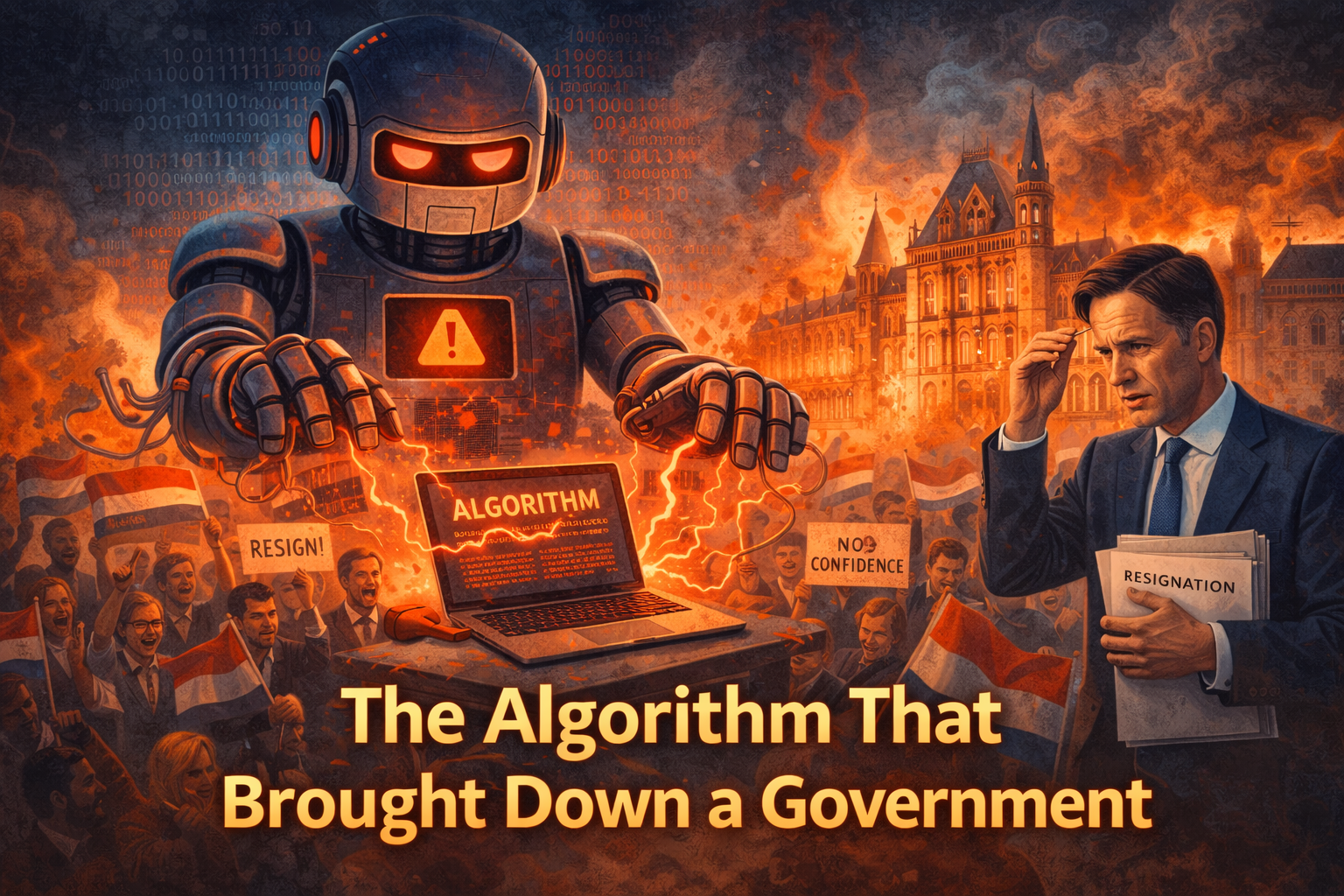
The Algorithm That Brought Down a Government
🔴 REAL INCIDENT: The Dutch "Toeslagenaffaire" (Benefits Scandal) - 2013-2021
What Happened
On January 15, 2021, the entire Dutch government resigned.
Prime Minister Mark Rutte and his cabinet stepped down after a parliamentary inquiry revealed what investigators called "unprecedented injustice": an automated fraud detection system had wrongly accused over 26,000 families of benefits fraud, demanding repayment of tens of thousands of euros each.
Families lost their homes. Marriages collapsed. Children were taken into foster care. Some victims took their own lives.
The AI system had operated for nearly a decade. Its victims had been fighting—and losing—for years. The inquiry found that the government had violated "fundamental principles of the rule of law."
It remains the largest AI governance failure in the history of democratic government.
How It Started
In 2013, the Dutch Tax Authority implemented an automated risk profiling system to detect fraud in childcare benefits (kinderopvangtoeslag). The Netherlands provides generous childcare subsidies to working parents—and wanted to ensure the money wasn't being misused.
The algorithm scored benefit recipients based on dozens of factors:
- Incomplete applications
- Minor errors in paperwork
- Changes in circumstances
- "Risk indicators" that were never fully disclosed
High-risk scores triggered investigations. Investigations often resulted in demands for full repayment of benefits—sometimes going back years.
The system was designed to be efficient. It was.
The Cascade of Harm
The false positives: The algorithm flagged thousands of families as fraudsters based on minor administrative errors—a wrong checkbox, a delayed document, a small discrepancy in income reporting.
But the system didn't distinguish between genuine fraud and innocent mistakes. A missing signature could trigger the same response as systematic deception: full repayment demanded, benefits suspended, no appeal.
The collection machinery: Once flagged, families faced an automated collection process that was nearly impossible to stop. The Tax Authority demanded repayment of €10,000, €30,000, sometimes €100,000 or more.
Parents working minimum-wage jobs were told to repay years of childcare benefits. The government seized wages, blocked bank accounts, and reported families to credit agencies.
The racial dimension: Investigators later found that the algorithm disproportionately targeted families with dual nationality. Having a non-Dutch surname or second nationality increased your "risk score"—a form of automated racial profiling embedded in the system.
The human cost: Unable to pay, families lost their homes. Parents couldn't afford childcare and lost their jobs. Marriages collapsed under financial stress. Children were removed by child protective services from parents deemed unable to provide.
Some victims took their own lives.
Why It Took So Long
The victims fought back. For years. They filed complaints, hired lawyers, wrote to politicians. They were ignored.
The presumption of guilt: Once the algorithm flagged you, the burden of proof reversed. Families had to prove they weren't fraudsters—an almost impossible task when the system's logic was opaque.
The automated denials: Appeals were processed through the same system that had flagged them. Computer says no.
The institutional defensiveness: Tax Authority officials defended the system even as evidence mounted. Internal critics were silenced. Documents were withheld from courts.
The complexity shield: When questioned, officials hid behind the algorithm's complexity. No one could fully explain why specific families were flagged. The system had become its own justification.
A parliamentary inquiry in 2020 finally broke through. Investigators found that officials had known about the problems for years—and chosen to ignore them.
The Reckoning
The parliamentary report, titled "Unprecedented Injustice," found:
- 26,000+ families were wrongly accused
- 1,115 children were placed in foster care, in cases now under review
- The government violated "fundamental principles of the rule of law"
- Officials showed "tunnel vision" and "institutional bias"
- Victims were denied due process for nearly a decade
The cabinet resigned. Criminal investigations began. A compensation fund was established—though many victims say the money can never repair the damage.
Prime Minister Rutte, who had led the government throughout the scandal, called it "a great injustice that has affected thousands of families."
He was later re-elected anyway.
The Pattern It Reveals
The Netherlands isn't unique. Similar algorithmic systems operate in governments worldwide:
Australia's Robodebt: Automated debt recovery accused hundreds of thousands of welfare recipients of fraud. A Royal Commission found the scheme unlawful. The government paid $1.8 billion in compensation.
UK Universal Credit: Automated systems have been accused of wrongly denying benefits, with limited appeal mechanisms for affected families.
US Healthcare: Algorithmic prior authorization systems deny medical claims automatically, with some insurers processing hundreds of thousands of denials through AI.
The pattern is consistent: automation applied to benefits without adequate oversight, with devastating consequences for the most vulnerable.
Why This Happens
Efficiency over accuracy: Automated systems are deployed to save money and reduce fraud. But the metrics that matter—cost savings, fraud detected—don't capture the harm caused by false positives.
Asymmetric power: When an algorithm denies your benefits, you're fighting a system with infinite patience and no empathy. The burden of proof shifts to the victim.
Opacity as defense: Complex algorithms become their own justification. "The system flagged you" becomes an answer that nobody can question.
Missing feedback loops: The victims who suffer false positives are often the least able to fight back. Their complaints don't generate the data that would expose the system's failures.
Institutional incentives: Officials who catch fraud are rewarded. Officials whose systems destroy innocent families face no consequences—until a parliamentary inquiry forces accountability.
How It Could Have Been Prevented
The Dutch system lacked every safeguard that should govern high-stakes automated decisions:
Human review for adverse actions: Any automated decision to demand €50,000 from a family should require human verification.
Proportionate responses: Minor administrative errors should not trigger catastrophic consequences.
Transparent criteria: People have a right to understand why they've been flagged—and to challenge faulty logic.
Bias auditing: Algorithmic systems should be tested for disparate impact, especially on racial or ethnic minorities.
Appeal mechanisms that work: When the appeal process goes through the same automated system, it's not really an appeal.
Outcome monitoring: If thousands of families are being flagged, someone should be checking whether those flags are accurate.
The Lesson
The Dutch welfare algorithm did exactly what it was designed to do: identify risk and trigger collection.
The problem was what it was designed to do. The system prioritized efficiency over justice. It treated citizens as fraud risks to be managed, not people to be served.
When an algorithm can destroy a family's life, governance isn't optional. Oversight isn't bureaucracy. Human review isn't inefficiency.
They're the difference between a functioning democracy and a machine that brings down governments.
Your automated systems are making decisions about people's lives right now. Who's watching?
Sources: