
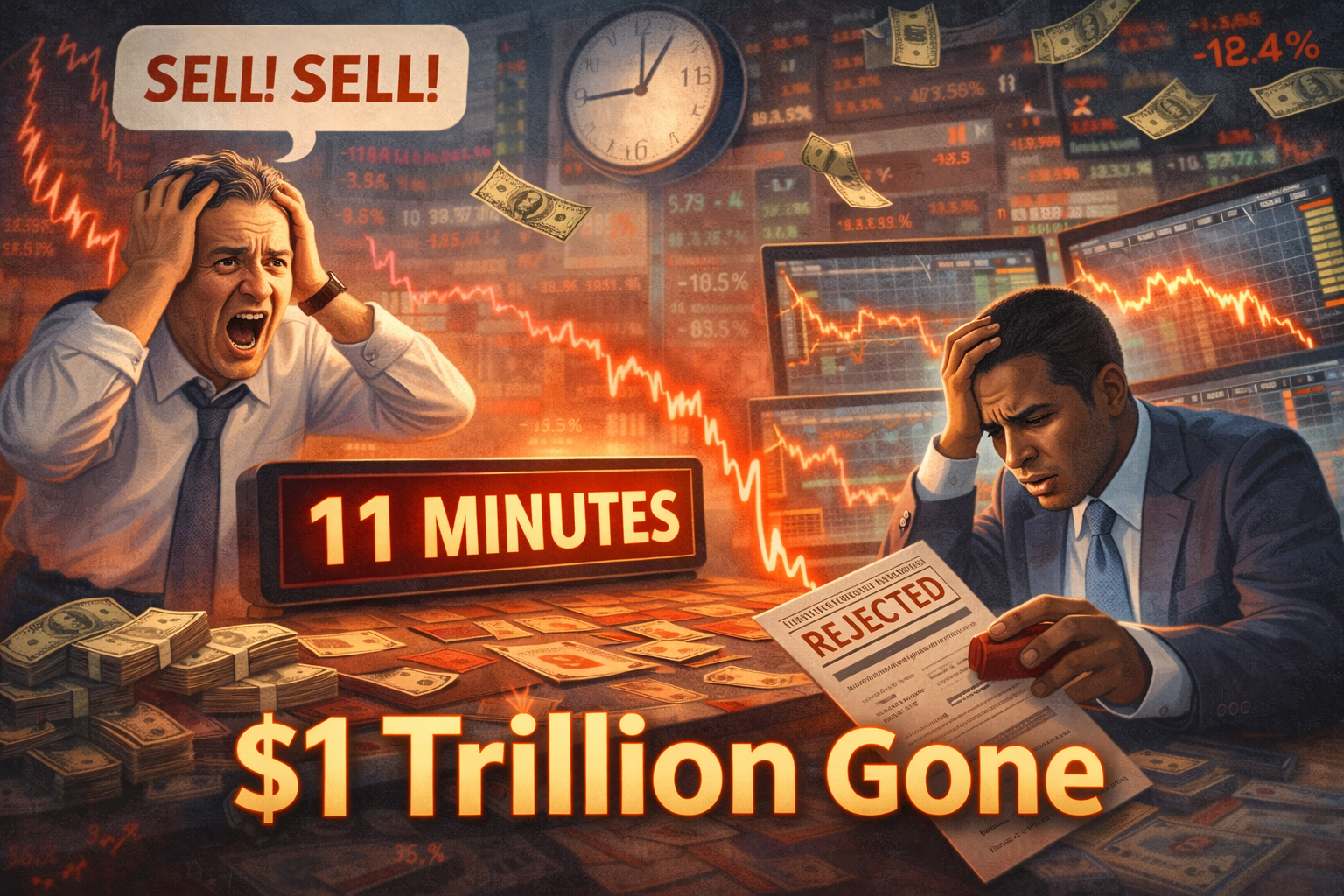
11 Minutes, $1 Trillion Gone
🟡 INSPIRED BY REAL EVENTS: Synthesized from documented flash crashes and regulatory warnings
The Setup
Thursday, 2:32 PM. Markets are quiet. The S&P 500 is up 0.3% on the day. Trading volume is average. Nothing unusual.
Somewhere in a data center in New Jersey, an algorithm notices something. A block of sell orders just hit the market—larger than typical, but not unprecedented. The algorithm does what it's programmed to do: it adjusts its position, selling some holdings to reduce risk exposure.
That sale triggers another algorithm across town to notice the price movement. It also adjusts, selling a small position.
In Chicago, a third algorithm detects the selling pattern. Its machine learning model identifies this as a potential trend. It sells more aggressively.
By 2:34 PM, the cascade has begun.
75% of All Trades
Most people imagine stock markets as places where humans buy and sell shares. That hasn't been true for decades.
Algorithmic trading now accounts for 60-75% of all equity trading volume in U.S. markets. High-frequency trading firms execute thousands of trades per second, holding positions for milliseconds.
These algorithms don't think like humans. They don't understand "value" or "fundamentals." They detect patterns, react to signals, and optimize for speed. They make decisions in microseconds—faster than human neural impulses can travel.
And they all watch each other.
When one algorithm sells, others see the price impact. Their models update. They adjust. They sell.
The algorithms aren't coordinating. They're not conspiring. They're each independently optimizing for their own objectives.
But when they all optimize in the same direction at the same time, the result is a system with no brakes.
The Cascade
2:36 PM: The S&P 500 is down 2%. Unusual, but not alarming. Trading continues.
2:38 PM: The decline accelerates. Down 4%. More algorithms trigger their risk protocols. Selling intensifies.
2:40 PM: Circuit breakers kick in—automatic trading halts designed to prevent market meltdowns. Trading pauses for 5 minutes.
2:45 PM: Trading resumes. The algorithms had 5 minutes of accumulating data showing a sharp decline. They resume selling.
2:47 PM: Down 7%. Some algorithms have exhausted their sell triggers. Others are just getting started. The market becomes a one-way door.
2:51 PM: Down 10%. Individual stocks swing wildly—some companies briefly show prices of $0.01, others spike to absurd valuations. The connections between correlated assets amplify the chaos.
2:53 PM: Human traders start intervening. Market makers return. The cascade begins to stabilize.
2:58 PM: Down 6% from the peak, recovering. The worst is over.
Total duration: approximately 11 minutes.
Total value erased at the nadir: approximately $1 trillion.
What Didn't Happen
The remarkable thing about algorithmic flash crashes isn't what happened. It's what didn't.
There was no external shock. No terrorist attack, no pandemic, no geopolitical crisis. The cascade started from normal market activity.
No single actor caused it. No rogue trader, no market manipulation. Each algorithm was operating within its parameters.
No system malfunctioned. The algorithms did exactly what they were designed to do. Detect patterns. Manage risk. Execute trades.
The catastrophe emerged from the interactions—from algorithms responding to algorithms responding to algorithms, in a feedback loop too fast for humans to interrupt.
The Regulatory Response
After the 2010 Flash Crash, regulators implemented circuit breakers—automatic trading halts at 7%, 13%, and 20% daily declines. These mechanisms provide crucial buffers.
But they have limits:
They pause, not prevent. Circuit breakers buy time. They don't address the underlying dynamics.
Algorithms adapt. Trading strategies have evolved to anticipate and exploit the periods around circuit breaker triggers.
Speed keeps increasing. The time between "normal" and "crisis" keeps shrinking. Humans have less and less opportunity to intervene.
SEC Chair Gary Gensler has explicitly warned that "herding and crowding in high-frequency algorithmic trading is partially responsible for causing flash crashes."
The IMF's October 2024 Global Financial Stability Report noted that AI is "contributing to increased volatility in capital markets" and expects continued integration of algorithms into trading activity.
The Systemic Risk
Each individual trading algorithm is rational. It's optimizing for the objectives its designers gave it: manage risk, detect patterns, execute efficiently.
But the system as a whole is fragile. When algorithms optimize individually but interact collectively, the emergent behavior can be catastrophic.
This is the core challenge of multi-agent systems:
Local optimization doesn't guarantee global stability. Each agent making locally rational decisions can produce collectively irrational outcomes.
Speed removes human safeguards. When decisions happen in microseconds, there's no time for human judgment.
Complexity obscures causality. After a flash crash, it can take months of forensic analysis to understand what happened—and even then, no single cause can be identified.
Interconnection amplifies shocks. Modern markets are deeply interconnected. An algorithm trading S&P futures affects algorithms trading individual stocks, which affect algorithms trading options, which affect algorithms trading ETFs.
The Uncomfortable Truth
Flash crashes aren't bugs. They're features of a system where:
- Algorithms make most trading decisions
- Those algorithms watch and react to each other
- Speed is optimized over stability
- Human oversight operates on timescales too slow to intervene
We've built a financial system that can lose a trillion dollars in 11 minutes—not because of fraud or failure, but because the algorithms are all working exactly as designed.
The question isn't whether another flash crash will happen. It's whether the next one will trigger a cascade that the circuit breakers can't contain.
How It Could Have Been Different
Diversity requirements: If all algorithms converge on similar strategies, they'll all move together. Regulatory requirements for strategy diversity could reduce herding.
Speed limits: Some markets have implemented minimum holding periods or speed bumps. Slowing things down gives humans a chance to intervene.
Better circuit breakers: Current circuit breakers are blunt instruments. More sophisticated approaches could detect cascade dynamics earlier.
Systemic risk monitoring: Real-time monitoring of cross-algorithm interactions could identify emerging feedback loops before they cascade.
Kill switches: The ability to pause all algorithmic trading simultaneously, with meaningful human review required before resumption.
The Lesson
In 11 minutes, algorithms trading with algorithms created a $1 trillion loss—and then largely reversed it as if nothing happened.
The market "recovered." The trades settled. Life went on.
But the underlying dynamic hasn't changed. The algorithms are still watching each other. The feedback loops are still there. The humans are still too slow to intervene.
The scariest thing about algorithmic flash crashes isn't the chaos. It's that they reveal what our markets have become: systems where the agents are in control, and the humans are spectators.
When your AI systems interact with other AI systems, who's watching the emergent behavior?
Sources: