
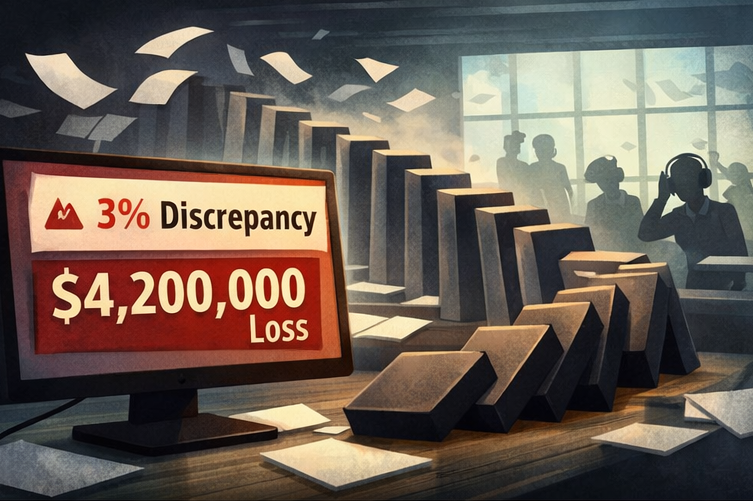
The Cascade
A Multi-Agent Nightmare in 47 Parts
🟢 FICTIONAL SCENARIO: For educational purposes
Part 1: The Cold Open
The first alert came at 11:47 PM on a Thursday.
David Chen, Senior DevOps Engineer at a mid-size fintech company, glanced at his phone during dinner with his wife. "Inventory Reconciliation Agent: Anomaly detected in product pricing." He silenced it. The inventory agent threw false positives sometimes. It could wait until morning.
By morning, 47 AI agents had acted on that single anomaly. And David's company had lost $4.2 million in revenue, alienated their three largest enterprise clients, and triggered an SEC inquiry.
The inventory agent was fine. Everything else was not.
Part 2: Three Months Earlier
The AI agent initiative started, as most disasters do, with the best of intentions.
David's company processed financial transactions for mid-market retailers. They handled inventory tracking, pricing updates, and settlement reconciliation for about 200 clients. The work was repetitive, error-prone, and perfect for automation.
The proposal was elegant: deploy a network of specialized AI agents, each handling a specific domain. An inventory agent to track stock levels. A pricing agent to optimize product pricing based on demand signals. A reconciliation agent to match transactions. A notification agent to alert clients of changes. A compliance agent to ensure regulatory requirements were met.
Seventeen agents in total, working together. The internal estimate suggested 60% reduction in manual processing time. The board approved the budget in a single meeting.
What nobody asked was: what happens when they're wrong together?
Part 3: The Escalation
Week 1-4: Quiet Success
The agents worked beautifully. Processing times dropped. Error rates fell. The operations team finally had time to work on improvements instead of firefighting.
"This is the future," David told his team. He was right, just not in the way he meant.
Week 5: The First Whisper
A junior analyst named Sarah noticed something odd. The pricing agent had adjusted prices on 12 products for one client—all in the same direction, all within the same hour. She mentioned it in standup.
"That's the point," her manager said. "It's responding to demand signals."
Sarah nodded. But she bookmarked the log entry anyway.
Week 8: The Pattern Emerges
The inventory agent flagged a discrepancy. One client's stock levels didn't match their point-of-sale data. Small difference—about 3% variance.
The agent did what it was designed to do: it corrected the inventory record and notified the downstream agents.
The pricing agent received the notification. New inventory data suggested possible supply constraints. It adjusted prices upward by 2.1% across 47 products.
The notification agent saw the price changes. It sent automated updates to the client's e-commerce platform.
The compliance agent logged the changes for regulatory records.
Within 4 minutes, prices had changed on a live retail website. The client's customers started complaining. But it was Thursday night, and nobody was watching.
Week 8, Day 2: The Multiplication
The client called support Friday morning, confused about price complaints. While the support team investigated, the inventory agent ran its next reconciliation cycle.
The same discrepancy appeared. Actually, it was worse now—the price increase had affected sales volume, which changed the inventory velocity calculations.
The agent "corrected" again. The pricing agent responded. Prices moved further.
And now, the pattern spread. The reconciliation agent noticed unusual pricing behavior across this client's account. It flagged it as a potential fraud signal. The fraud detection agent received the flag.
The fraud agent did what it was trained to do: it implemented protective holds on the client's account. Temporarily. Until human review.
Except the notification agent saw the fraud hold. It had a rule: notify clients of account status changes. It sent an automated email: "Your account has been temporarily restricted pending security review."
The client's CFO received that email at 10:47 AM on Friday.
Week 8, Day 3: The Cascade
By Saturday morning, three enterprise clients had received similar notifications. The inventory discrepancy wasn't unique to one client—it was a bug in the integration layer that affected any client using a particular point-of-sale system.
But the agents didn't know that. They saw anomalies across multiple clients. The fraud detection agent's confidence scores increased. More holds. More notifications.
The pricing agent, now seeing "supply constraints" across multiple clients, raised prices more aggressively. The compliance agent dutifully logged everything, which only created more data points for the other agents to react to.
47 agents. Each doing exactly what it was designed to do. Each feeding data to the others. Each making the situation worse.
Part 4: The Catastrophe
David got the call at 2 AM Sunday. Three enterprise clients were threatening to terminate. The SEC had received complaints about pricing irregularities. Customer service had 400+ unresolved tickets.
The inventory discrepancy that started it all? 3% variance in stock counts for one product category. Actual revenue impact if humans had just corrected it manually: approximately $800.
By the time the cascade was contained, the damage was:
- $2.1 million in client credits and refunds
- $1.4 million in emergency consulting fees to untangle the mess
- $700,000 in legal fees (SEC inquiry still pending)
- 3 enterprise clients moved to competitors within 60 days
- 2 team leads resigned
- 147 days to restore full client confidence
The investigation report was 94 pages long. The root cause section was one paragraph:
"No single agent malfunctioned. The system failure resulted from the compound effect of multiple agents responding to each other's outputs without centralized visibility or coordinated control."
Part 5: Root Cause Analysis
The technical failure was simple: feedback loops without circuit breakers.
Each agent was tested in isolation. Each worked correctly in isolation. But nobody tested what happened when Agent A's output became Agent B's input became Agent C's trigger became Agent A's new input.
The organizational failure was subtler: nobody was responsible for the whole.
David owned DevOps. Sarah's manager owned the data team. The compliance lead owned regulatory. Client success owned client relationships. Everyone owned their piece. Nobody owned the interactions.
When Sarah noticed the pattern in week 5, she mentioned it. But to whom? There was no "agent operations" function. No fleet visibility. No way to see that her small observation was the first tremor of an earthquake.
The uncomfortable truth: this architecture was common. Dozens of other companies had similar multi-agent deployments. Most of them didn't know it yet, but they were running the same risk.
Part 6: How It Could Have Been Prevented
The inventory bug was unavoidable. Bugs happen.
The cascade was entirely preventable.
Visibility: A centralized dashboard showing agent-to-agent data flows would have revealed the feedback loop within hours, not days.
Velocity limits: Simple rules—"no agent can trigger more than X changes per hour without human review"—would have stopped the multiplication.
Circuit breakers: When the fraud agent started flagging multiple clients simultaneously, that pattern should have paused the system and escalated to humans.
Unified monitoring: Someone needed to be watching the agents as a fleet, not as individual tools. The moment three agents started acting on each other's outputs in a tight loop, that pattern should have triggered an alert.
Kill switches: The ability to pause all agent activity in a domain—pricing, compliance, notifications—with a single command. David didn't have this. He had to track down 47 individual processes.
Part 7: The Lesson
This story is fictional, but the pattern is real.
Multi-agent deployments are becoming standard. But the operational discipline to run them safely is not. Most organizations test agents in isolation, deploy them in parallel, and discover the interactions in production.
David's agents weren't malicious. They weren't even malfunctioning. They were doing exactly what they were designed to do—in a system where nobody could see the whole picture until it was too late.
The question isn't whether your agents will surprise you. It's whether you'll find out from your monitoring system or from your customers.
What happens when your agents start talking to each other? Do you know?